From Engagement to Impact: How Digital Mobility Monitoring Drives Gait Speed Improvement and Reduces Fall Risk
How OneStep’s High-Frequency Mobility Monitoring Translates to Faster Functional Improvement
Gait speed is widely recognized as the “sixth vital sign,” strongly associated with fall risk, hospitalization, and functional independence. But an impor tant clinical question remains: Does how often we measure functional mobility influence how well patients improve? We analyzed mobility data from 5,000+ patients across six healthcare organizations bet ween 2023–2025 to explore this relationship.
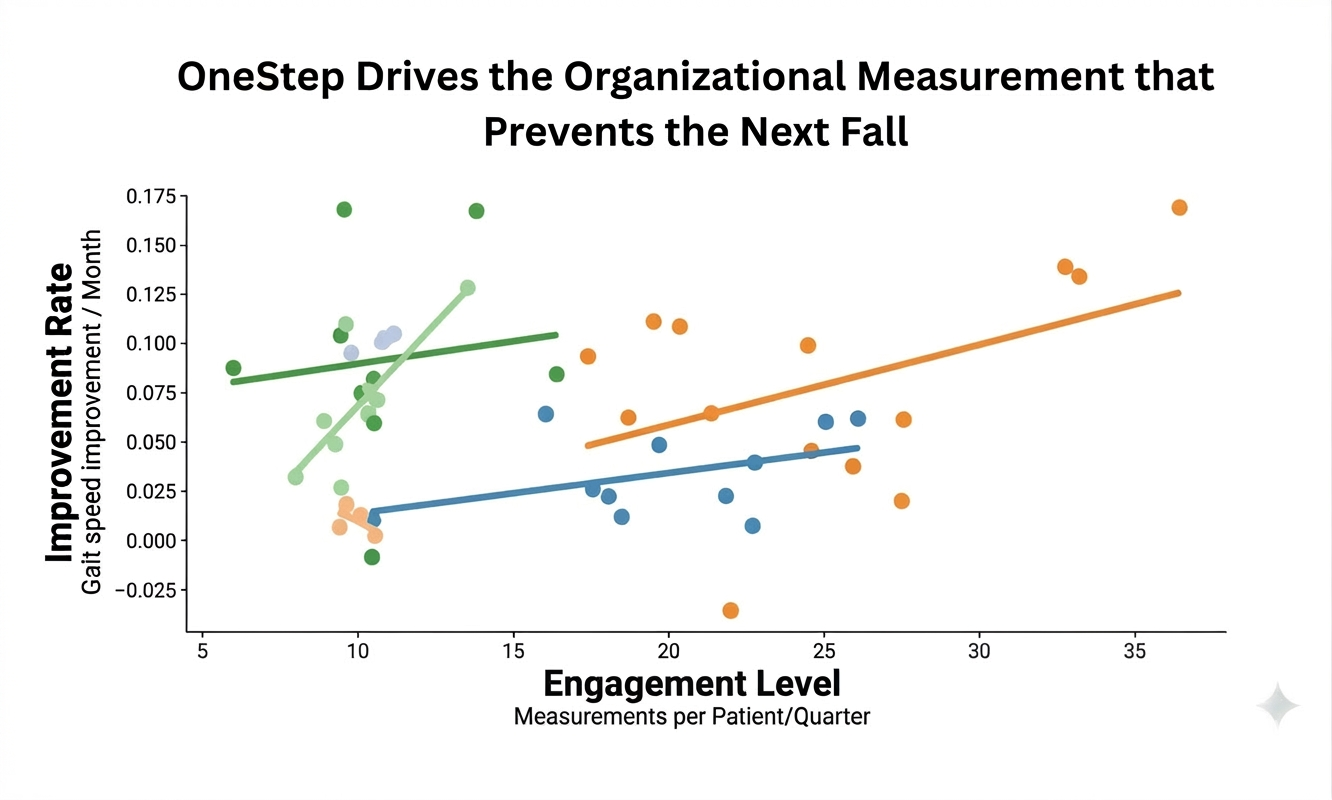
Organizations with higher functional mobility measurement frequency demonstrated greater improvements in population gait speed over time.
How to read this chart:
• Each dot represents an organization during a specific quar ter of care
• X-axis: Average number of mobility measurements per patient per quarter
• Y-axis: Monthly rate of gait speed improvement
• Colors: Different healthcare organizations
• Trend lines illustrate the relationship between measurement frequency and functional improvement within each organization
Across organizations, quarters with higher measurement frequency consistently demonstrate greater gait speed improvement rates. This suggests that frequent mobility monitoring may support earlier intervention and faster functional recovery.
Why measurement frequency may influence outcome
Frequent mobility monitoring enables clinicians to:
✔️ Identify stalled or declining progress earlier
✔️ Adjust therapy sooner
✔️ Reinforce patient engagement through regular feedback
✔️ Gain visibility into real-world mobility performance
Measurement Frequency as a Clinical Lever
Digital health engagement is often viewed as an operational metric. But when mobility measurement is associated with faster functional improvement , engagement becomes clinically meaningful. Measurement frequency may influence recovery trajectories.
Engagement with frequent mobility monitoring is not just platform use- it can be part of the clinical pathway
✔️ Detect decline earlier
✔️ Intervene sooner
✔️ Accelerate functional recovery
Clinical Implications
Frequent mobility monitoring may influence recovery trajectories by enabling earlier detection of functional decline and faster therapy adjustments. Consistent visibility into mobility trends allows clinicians to inter vene sooner and support improved outcomes across patient populations. OneStep is committed to setting a new standard for proactive mobility care.