
.png)
What happens after joint replacement surgery may depend, in part, on what we measure before it.
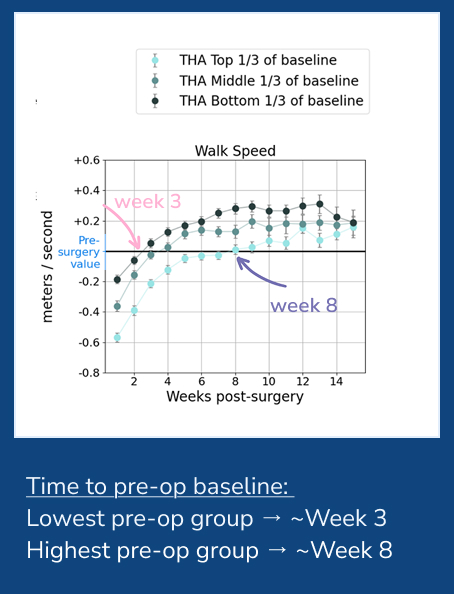
In an analysis of more than 1,200 patients undergoing total hip and knee replacement, pre-operative gait performance was strongly associated with how patients’ recovery trajectories unfolded after surgery.
Patients who entered surgery with stronger gait performance consistently maintained higher absolute levels of mobility throughout recovery. But patients starting with lower gait performance often showed larger relative improvements and, in the THA population, many returned to their own pre-surgery walking speed earlier.
That distinction matters.
A patient’s relative improvement doesn’t necessarily reflect their absolute function or tell the full story of whether their recovery is successful.
By objectively measuring gait before surgery, providers can establish a functional starting point and better understand the recovery trajectory a patient is likely to follow. Continued measurement after surgery can then provide context for whether that patient is progressing as expected or beginning to deviate from their anticipated path.
This suggests a more individualized way to interpret recovery: not against a single benchmark, but relative to the patient’s own starting point and expected trajectory.

When we know where a patient started, the measurements that follow become much more meaningful and potentially much more actionable.